The science is getting more interesting. The supply chain hasn’t caught up. Here’s what one of the world’s best-known ageing researchers said about peptides, and what it means if you’re buying them.
The science is getting more interesting. The supply chain hasn’t caught up. Here’s what one of the world’s best-known ageing researchers said about peptides, and what it means if you’re buying them.
Peptides have gone mainstream
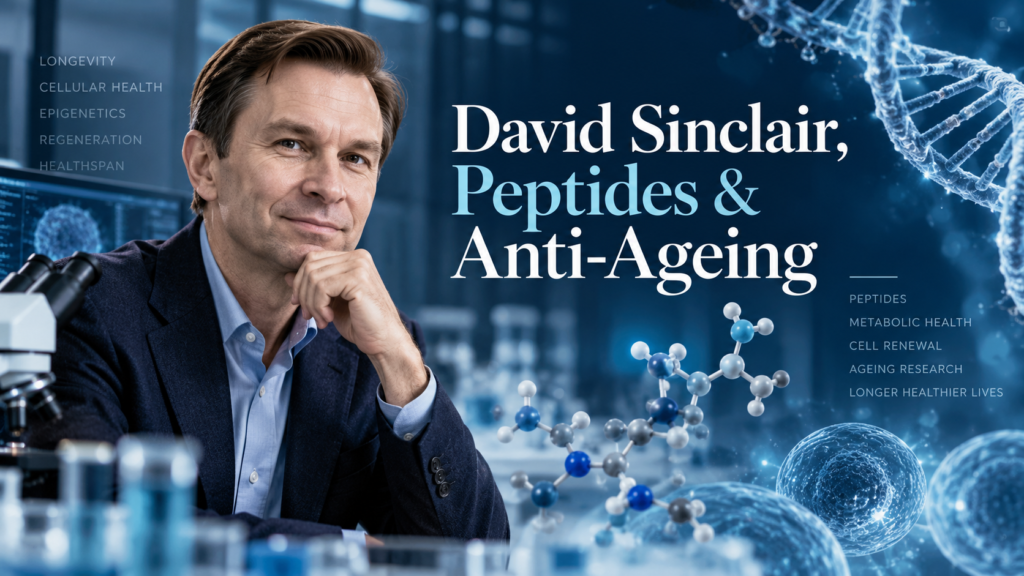
Harvard Medical School geneticist Dr David Sinclair; and he’s Australian by the way; has spent two decades at the center of longevity science. In October 2026 he devoted an episode of his podcast, Lifespan with Dr David Sinclair (Season 2, Episode 11, “Peptides: Hype or Miracle?”), to the compounds everyone keeps asking him about.
And they really are asking. Sinclair says strangers now stop him with peptide questions, including a border officer on his way out of Canada who wanted to know which one to take for sleep. He compared the moment to the earlier waves of interest in resveratrol and NMN.
His explanation for the boom is simple: GLP-1 medicines such as semaglutide made self-injection at home socially normal. Once people were comfortable with a pen or a syringe, the door opened to a much wider, and much less tested, range of peptides.
The peptides Sinclair was optimistic about
Sinclair mapped each compound against the recognised hallmarks of ageing, the biological processes that drive decline over time. Here is what he found promising.
GHK-Cu: the copper peptide
GHK-Cu is a tiny three-amino-acid peptide (glycine, histidine, lysine) that binds copper, and the body makes it naturally. Sinclair explained that it may help cells take up copper, which is needed both for SOD1, one of the body’s key antioxidant enzymes, and for stable collagen. Through that antioxidant activity, it may help dampen chronic inflammation, itself a hallmark of ageing.
The ageing angle is striking: blood levels of GHK-Cu fall from roughly 200 ng/mL around age 20 to about 80 ng/mL by age 60, according to a 2018 review. Sinclair described it as widely used for skin and tissue repair.
The caveat: the main reviews come from the researchers who discovered the peptide, not from independent clinical trials.
Epitalon: the telomere peptide
Epitalon is a four-amino-acid peptide developed in Eastern Europe. Its best-known result is a 2003 study in which it switched on telomerase and lengthened telomeres (the protective caps on our chromosomes that shorten with age) in human cells. Sinclair added that it may also act on the epigenetic marks that keep the telomerase gene silenced.
The caveat: these effects have so far been seen in a lab dish. Sinclair noted that, to his knowledge, no long-term safety studies exist.
Apelin: the exercise peptide
Apelin is an “exerkine”, a signal your body releases when you exercise. A 2018 Nature Medicine study found that apelin production drops with age in both humans and rodents, and that restoring apelin signalling in old mice improved muscle function. Sinclair walked through the mechanisms: it engages the energy sensor AMPK and the autophagy starter ULK1 while turning down mTOR, the same longevity pathways targeted by exercise, fasting and rapamycin research. He also pointed to work suggesting it preserves stem cells, quiets inflammatory signals from senescent cells and, in a late-2025 mouse study, protected spinal discs.
One human trial built on the idea has already failed. Sinclair’s view was that the biology looks sound, and that what remains is “an engineering problem”.
The caveat: human evidence is associational, not causal. Side effects seen in trials include low blood pressure, rapid heart rate and dizziness, and apelin is not an approved medicine.
Collagen peptides: a change of mind
Perhaps the most notable moment: Sinclair revised his earlier scepticism about collagen supplements. He now considers small collagen fragments, particularly those carrying hydroxyproline, to be biologically active, with the potential to switch on cell-survival pathways and the enzymes that make hyaluronic acid, which keeps skin supple and joints cushioned.
The published data partly back him up. A 2023 meta-analysis pooling 26 human trials and 1,721 participants found hydrolysed collagen improved skin hydration and elasticity against placebo, while a 2026 analysis found clearer gains in hydration than in wrinkles or elasticity.
And GLP-1s
Sinclair left GLP-1 drugs out of this episode, but he has previously described them as longevity drugs, a sign of how seriously he takes peptide-based medicine when the human evidence is strong.
What Sinclair was careful to say
This was not a sales pitch, and that is what makes it worth reading closely. Alongside the optimism, Sinclair was blunt about the limits:
- Most of the evidence is from cells and animals. Human data are thin and long-term safety is largely unknown.
- Peptides are hard to study. Most must be injected because they don’t survive digestion, and repeatedly handling and injecting mice stresses them enough to shorten their lives, which muddies any lifespan experiment.
- The market is a grey zone. Changing a single amino acid can create a technically new molecule that does the same job: easy to patent, easy to design around. Many products are sold “for research purposes”, and buyers end up running uncontrolled experiments on themselves.
- Most supply comes from China. Sinclair said this of the US market, and the pattern is familiar to Australian buyers too.
- Regulation is shifting. Sinclair said a US FDA compounding advisory committee voted on 24 July 2026 to place at least six peptides on the agency’s 503A bulks list.
- Talk to your doctor. And, in his view, a doctor who refuses to discuss peptides at all isn’t helping patients make informed decisions.
It’s worth noting that Sinclair has drawn criticism in the past for going further than the data on age-reversal claims. That makes his restraint here all the more telling: even one of the field’s most optimistic voices says the human evidence isn’t in yet.
The gap between promising science and the vial in your hand
Read Sinclair’s comments as a whole and a clear picture emerges. The biology of some peptides is genuinely interesting. The weak link is everything between the lab paper and the product that arrives at your door: grey-market sellers, “research use only” labels, overseas manufacturing, and paperwork you have no easy way to check.
A promising molecule is only promising if the vial actually contains it, at the strength on the label. That’s the problem PepiScreen was built to address, through three checks:
- Proof, before you buy: can the seller’s certificate of analysis be tied to a real lot number, a rated third-party lab, a named selling entity and a verification route that actually resolves?
- Price, before you buy: where does the price sit against the market for that molecule at that vial size? Unusually cheap isn’t proof of anything, but it’s a fair question to put to a seller.
- Match, when it arrives: does the COA you were shown match what you received?
Why Match matters: in our own data on BPC-157, delivered content averaged close to label, about 101%, but individual results ranged from 84% to 132%. An average can look fine while a single vial is a long way off.
We don’t tell anyone which peptide to take, or how much. As Sinclair says, that conversation belongs with your doctor. What we can do is help you judge whether the evidence a seller hands you deserves to be trusted.
The bottom line
Dr David Sinclair sees real promise in peptides like GHK-Cu, epitalon, apelin and collagen fragments, each touching a different hallmark of ageing. He also says, plainly, that most of that promise has yet to be proven in people, and that the market selling them is running well ahead of the science.
Both things can be true. If you’re exploring peptides, the most useful step you can take is to speak to a doctor about whether they’re right for you, and to make sure that whatever you buy is what it claims to be.
PepiScreen is independent and has no affiliation with Dr David Sinclair, the Lifespan podcast or any supplier mentioned. This article is general information only, not medical advice. Many peptides are not approved for therapeutic use in Australia, and some are prescription-only medicines. Check with your doctor or the TGA before using any peptide.
Sources
- Lifespan with Dr David Sinclair, S2 Ep 11, “Peptides: Hype or Miracle?” (2026)
- Harvard’s David Sinclair Explores the Science and the Hype Behind Peptides, NMN.com, 19 Oct 2026
- Pickart & Margolina (2018), GHK-Cu review, Int J Mol Sci
- Khavinson et al. (2003), Epithalon and telomere elongation, Bull Exp Biol Med
- Vinel et al. (2018), The exerkine apelin reverses age-associated sarcopenia, Nature Medicine
- Pu et al. (2023), Oral collagen for skin anti-ageing meta-analysis, Nutrients
- Nukaly et al. (2026), Oral and topical peptides for skin ageing, Frontiers in Medicine
- López-Otín et al. (2023), Hallmarks of aging: an expanding universe, Cell
Get the free Peptide Market History Guide. A 12-page independent guide to the peptide market — how it evolved, the regulatory landscape, and how to read a Certificate of Analysis with a critical eye.
Send me the guide →